Archives of Place: Greg Staats
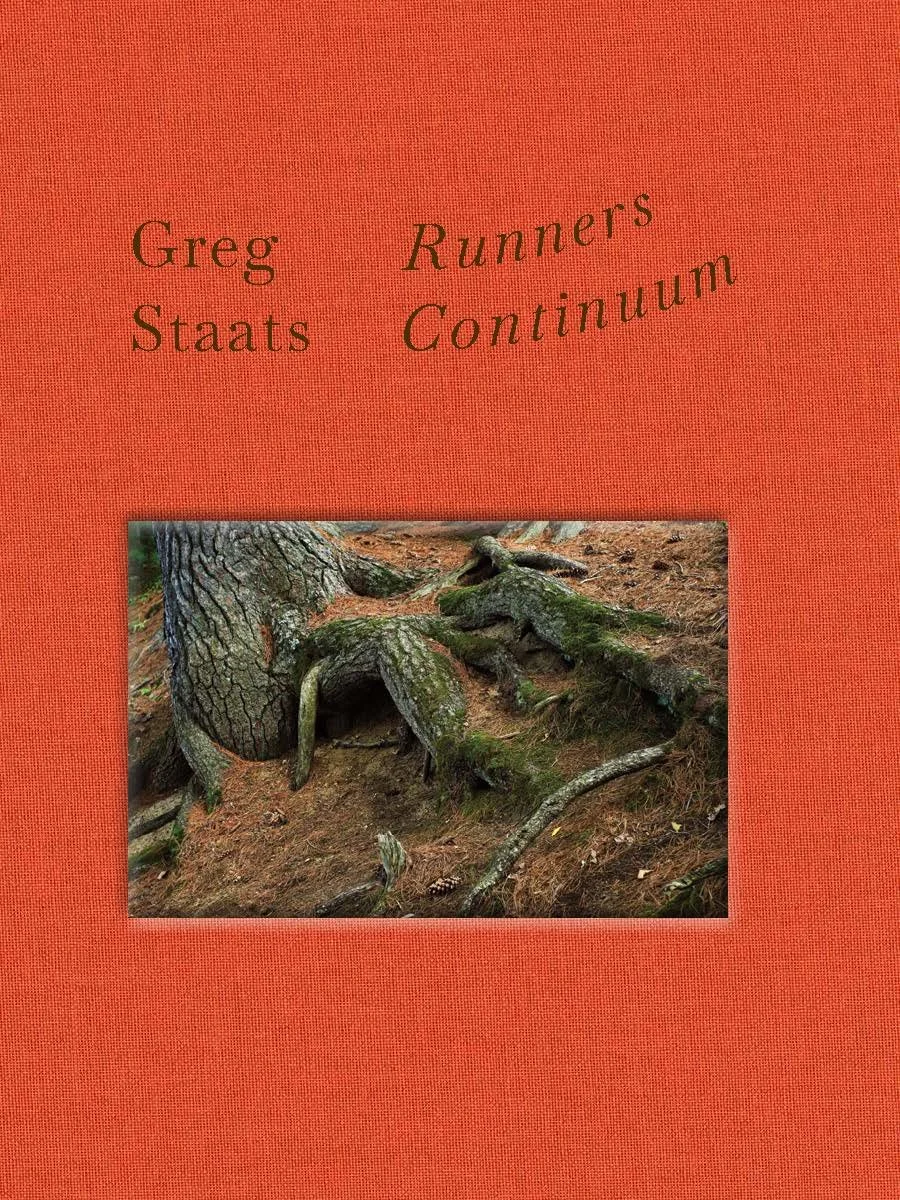
This is an essay commissioned by the Art Gallery of Hamilton for the exhibition Greg Staats: Runners Continuum, February 22 - May 18, 2025.
Archives of Place
“About this time,” Clarke tells us, “the king, or head-chief, of the Wyandotts, Sut-staw-ra-tse [Sastaretsi] called a meeting at the house of Chief Adam Brown, who had charge of the archives, which consisted of wampum belts, parchments, &c., contained in a large trunk. One by one they were brought out and shown to the assembled chiefs and warriors. Chief Brown wrote on a piece of paper, and tacked it to each wampum belt, designating the compact or treaty it represented, after it had been explained from memory by the chiefs appointed for that purpose. There sat before them their venerable king, in whose head were stored the hidden contents of each wampum-belt, listening to the rehearsal, and occasionally correcting the speaker and putting him on the right track whenever he deviated.”
—Horatio Hale, Four Huron Wampum Records: A Study of Aboriginal American History and Mnemonic Symbols (1897)
And the next figure, a line connecting two circles, but passing through five dots, I have assigned to the phrases which beg the founders to excuse errors of sequence and omission in ceremony as they anciently performed it when all the words were together.
—William N. Fenton, The Roll Call of the Iroquois Chiefs: A Study of a Mnemonic Cane from the Six Nations Reserve (1950)
Do’-gah – I don’t know, I don’t know because I don’t know my language.
—Greg Staats (2020)
Do’-gah – I don’t know [shrugging shoulders] (2020) culminates this narrative of cultural loss in recognition of the artist’s sense of rootlessness. [1] How might Greg Staats recover the path to the Good Mind? It doesn’t matter that deviation from this path was not his fault since he did not inherit his traditions but rather their destruction. After all, his deficits derive from displacements and consequent destructions, losses attendant upon the removal of the Hodinöhsö:ni’ from their traditional lands in the late eighteenth century, their settlement in Canada West, now southern Ontario, and the steady genocidal cultural depredations since then, which are at the source, as well, of the lateral violence of the reserve.
How, then, does one begin as an artist burdened with this history, and in Staats’s case sundered, as he says, by his “existential displacement” from the Kanien'kehá (Mohawk) and Skarù:ręˀ (Tuscarora) languages and their implicit relational worldviews? He was furthermore alienated by not belonging to the Longhouse and its traditions, as he was raised in a church-going family, and then moved off-reserve. Staats placed his trust in a Hodinöhsö:ni’ continuum of remembering as a way of recovery. To enable his practice he looked to “Indigenous methods of acquiring and retaining knowledge based on observing, reflecting, visiting, through orality, meaning, and image-making.” But as these were not automatically given, Staats had to work through the broken transmissions of his Indigenous cultural heritage to recover knowledge inherent, as he says, within “language, mnemonics and the natural world.” These were his signposts.
There were other signposts offered to Indigenous artists, but they were half in the Western system. When photographic, they employed the tropes of irony or critique; semiotic, they were images of the Indian, that is, images of an imaginary Indian, not the Indian imagining—or thinking. So, too, they were distanced, not the result of an embodied practice. Rather, Staats situated his work by thinking and feeling his way through Hodinöhsö:ni’ ceremonies of renewal or requickening such as the Midwinter or Condolence Ceremonies producing analogous works from his embodied understanding. Similarly, the Five Nations oral constitution, the Great Law of Peace, and ancient and ongoing cultural ceremonies, such as those performed “at the edge of the woods,” have been resources to move his art, and his healing, forward.
Staats wanders Six Nations of the Grand River with purpose, camera in hand. His landscape images, in black-and-white and colour, are stunningly beautiful, but not neutral, as they have symbolic import: as we look up, the image of the white pine is an ancient symbol of the unity of the Hodinöhsö:ni’ Confederacy; as we look down, its roots are a symbol of the word of peace spreading in all directions. For Staats, the land is a resonant archive disclosing a symbolic universe for those who have eyes to see clearly. But the images he captures show that the landscape also carries traces of violence, remnants of behaviours that are a legacy of state violence perpetrated by colonialism and the residential school system.
The Runner
In his wanderings through Six Nation’s territory, Staats wondered, what would it be like to be a runner? What responsibility would he be charged with? What message would he deliver? Traditionally, runners conveyed messages between Confederacy Council members, for instance, to call meetings of the fifty Title Holders (Sachems) of the Five Nations. Or, to announce the death of a Sachem, they would run either to the Older Brothers (Mohawk, Seneca, Onondaga) or Younger Brothers (Oneida, Cayuga), whatever the opposite affiliation, carrying a Wampum string, stopping at every Longhouse along the way to pronounce the sacred notification. [2] Pre-contact, what would they see on the way? On their path through the forest they would be constantly reminded of laws and obligations by the white pine, by its roots, or by the sumac or elderberry, from which it is said Ayenwatha had fashioned the first Wampum that was at the basis of the original Condolence Ceremony between him and the Peacemaker. “The things the people need to remember are constantly before their eyes.” [3] These things placed them, in the land and in a social contract. Trees and roots were embodied symbols; each time met, they were an incarnation of promise, a repetition of the original compact of the league. Runners were constantly reminded, uplifted, and encouraged by the landscape they passed through.
Post-contact, what would runners see? Say in 1969? That was the year of the Federal Government’s White Paper on Indian Policy, Prime Minister Pierre Elliott Trudeau’s and Minister of Indian Affairs Jean Chrétien’s attempt to be rid of the “Indian problem.” In effect it was a policy of legislated assimilation to be accomplished by means of subterfuge. In an extension of individual rights, Indian status would be dissolved, and Federal responsibility would be absolved. Titled after that year, the multi-panel 1969 (2021) is Greg Staats’s communication: a message delivered of his anger and frustration, nine placards of protest, because little seemed changed from that date. As such, it differs greatly from his earlier restorative aesthetic and elevates his current work from the personal to a political register. 1969 is what Staats saw along the way as he visited Six Nations. Strung together, the concatenation of images here is no Wampum Belt of friendship or treaty. Neither is it an allegory that Staats constructs, whose message we need decipher. (Remember, he is in the canoe and I am in the ship, [4] so the work can mean something other for him than to me, something I perhaps cannot know. See Staats’s notes to Do’-gah – I don’t know [shrugging shoulders] below.) Nonetheless, the assembled images can be individually parsed, even as they rhythmically and serially resonate in homonymic association.
Yet, under the real conditions of existence for Indigenous Peoples, resonance is as much disharmonic as harmonic. This contradiction, however, offers a double perspective; there is always a pathway to clarity within a negative environment and signs that lead a way through. [5] “Dissimilar images can also reveal unexpected affinities, as if they shadowed one another,” Staats writes. And similar images reveal disaffinities, too, one might add. Homonymic images implicitly demand a double point of view. With its underlining of “right” and “rite,” panel three of 1969 requires the attention of both eye and ear to distinguish difference. [6] So in 1969, it is a matter of how different images resonate with others. They answer to one another either sympathetically or antipathetically, in resistance or support, subtly shadowing one another, but not didactically. A case of the former is the association of the sumac and “stirring the ashes.” Of the latter, that of a Bread and Cheese Day (Victoria Day) demonstration on May 19, 1969, “protesting” what the cover of the Federal White Paper on Indian Policy published that fall would come to represent. Likewise in 1969, the healing image of the closing of the series 1969 [dna repair] responds to its opening image, 1969 [blanket], of a contamination of mould creeping in the corner of the ceiling of Staats’s father’s home.
Archives
The incorporation of archival images from newspapers is relatively new to Staats’s work and assumes different functions depending on their context within Staats’s own photographs. Sometimes, as in darkling ease (2021), Staats brings out a correlation between images drawn from his inherited archive of newspaper clippings, such as those of a murder from a November 18, 1947, Brantford Expositor article, “Police Probe Indian’s Death,” and those photographed in his wanderings, such as the excavated roots of a white pine, a damaged ancient Iroquois gravestone, or the blown-out walls of an on-reserve meth lab. In both 1969 and Runners Continuum (2024), clippings are chosen to mark dates of resistance and pertain in particular to the periodic revolts against the Federal Government’s imposition in 1924 of an Elected Council to usurp the authority of the Confederate Councils of Hereditary Chiefs and Clan Mothers, which had governed since Ayenwatha and the Peacemaker, reputed to be around 1050–1150. In March 1959, Warriors and Hereditary Chiefs expelled the Elected Council and occupied the Ohsweken Council House, only to be evicted by the RCMP. In June 1970, they again locked the doors on the Elected Council but were foiled by an injunction.
The syntax of Runners Continuum comes by way of 1969, with a notable difference. Here we are with Staats, close to the ground, moving slowly with him in the undergrowth as he captures images from Six Nations territory—white pine trees and Longhouse rafters above, firepit and roots below. But unlike 1969, there are no images of damage, distress, or the trace of violence. Even the uprooted tree harkens back to the origins of the Confederacy, when Peacemaker commanded that weapons be put out of sight by pulling up the great white pine and burying them beneath before replanting the tree. Continuing a movement upwards toward the light, white pines open and close the sequence of Runners Continuum. (As shared in conversation with the artist, the Six Nations Mohawk artist and educator Elizabeth Doxtater revealed that this reciprocity originates with Skywoman sharing breath with the celestial pine tree.) And even its images of revolt, culled from the Brantford Expositor, seem rather to attend to the centrality of women’s roles in Hodinöhsö:ni’ society—demoted by Federal policies—than signify only conflict, such as that provoked by the RCMP in panels five and eleven. (Traditionally, Clan Mothers chose new Title Holders, and continued to do so after 1924 even though governing authority was displaced to the Elected Council.) Interspersed as they are among images of nature, these women and girls nonetheless occupy a historical plane, captured in clippings. But in occupying this plane, by desiring to reinstate the governance of Title Holders, they seek to restore the natural balance of their Hodinöhsö:ni’ traditions. [7] Resistance within this temporal plane renews their enduring spiritual inheritance in the attempt to cancel colonial disruption.
The archive has always been a resource for Staats, if not the central source of his work, if we define the nature of an archive widely. From his family archive and the scrapbooks of newspaper clippings his father and grandfather kept of news of the reserve, to the records of ceremonies and mnemonics, such as that of the Condolence Cane or Roll Call Stick, to the land itself, “archives” guide his action. As he says of the land, “The dissociation brought about by my dilemma becomes a wandering with purpose that allows the gleaning of images and events as evidence stored within the land. Once this evidence is picked up, I then decode and present what a wordless trauma would look like…. Working through personal condolence countervails the dragging of an ancestral presence, which casts a traumatic shadow. The idea is to recognize that trauma precipitates a transitional stage of change.” [8] Wordless, this archive does not offer answers, but it stores the information one needs. Like his father and grandfather with their diaries and scrapbooks, Staats collects this evidence, which he takes as his obligation to bring to attention and share.
Gathering images is a placemaking practice. Every degradation of an original source, including the land itself, is still an archive, however deteriorated. For some who come later, like Staats, after the disturbance of traditions, “when all the words were together,” who receive only the trace of earlier destructions, those who seek some solace within their ceremonies and customs, the outcome is not hopeless but an opportunity for renewal. Teachings say that knowledge is never lost. Between each footstep, Staats gathers the knowledge still available in the land. All is not forgotten; there is always a way back from darkness into the light by various means of condoling. So when Staats wanders, he wanders with purpose, step by step recovering this knowledge in his photographs. At the edge of the woods, though uprooted and wandering, Staats chose his path to renewal, the only one possible, the healing decision of personal condolence, on his way to the good mind.
NOTES
1. Staats writes: “Do’-gah – I don’t know [shrugging shoulders], is a performative gestural mnemonic work whose source comes from my grade school Mohawk lessons and experiential perceptions within my community. The viewer is requested to perform all 60 phrases with and without the gestured shrugging. Carrying many levels of meaning, the work speaks to a systemic forgetting, lateral violence and trauma.
Do’-gah – 1. I do know but I refuse to tell you, just for today.
Do’-gah – 2. I need to remind you that you can’t know everything.
Do’-gah – 3. I don’t know, and because you asked me and expect a detailed answer, I feel shame and anger at once for the irony of the colonial systemic deficits and for your extractive expectation of presumed knowledge.
Do’-gah – 4. I don’t know and I refuse to find out for you.
Do’-gah – 5. I’ve heard you and will think about it. Time and reflection for considered response of what I shall tell you on my own time and to ensure cultural safety.
Do’-gah – 6. I do know and I need to tell you the protocols of our relations moving forward.
Do’-gah – 7. I don’t know my language.” “Soundings: Greg Staats,” exhibition text, Morris and Helen Belkin Art Gallery, last accessed October 15, 2024, https://belkin.ubc.ca/events/greg-staats/.
I have benefitted from many conversations with Greg Staats and a cultural overview of the essay by Six Nations artist and educator Elizabeth Doxtator.
2. No mere messenger, the runner was part of condoled group that included the Chief, Clan Mother, Sub-Chief, and Faithkeeper.
3. Kayanesenh Paul Williams, Kayanerenkó:wa: The Great Law of Peace (Winnipeg: The University of Manitoba Press, 2018), 332.
4. I refer here to the Two Row Wampum Treaty (ca. 1613) between the Dutch and Hodinöhsö:ni’.
5. Such as the sumac in panel four of 1969. Panel two shows an image of Keith Richards from the Rolling Stones’ disastrous 1969 Altamont concert. For Staats, Richards is a visual stand-in for the Warrior protests taking place at the same time at Six Nations. It’s Richards’s pointed gesture of warning that is important; he is like the eagle perched on top of the Great White Pine, assigned to watch for danger or the encroachment of evil. His face is obscured by a mnemonic, itself a stand-in for one of the Mohawk hereditary Title Holders, Teyonnhéhkwen, this name, that of a hardly fern, means life sustainer or sustenance.
6. This image derives from Staats’s father’s grade five dictionary, revealing perhaps an intuitive understanding on the boy’s part of the “righteous” relation of law and religion. But even within such a seemingly objective alphabetic listing, “rifts” appear as if between conservatism and revolt: between the “rigour” and “rigidity” of the “upright” and the “rise” of “revolt” and “riot,” leading to “risk” and “rivalry.” Indeed, the Great Law of Peace would be needed here.
7. Hereditary Chiefs and supporters also contested the Federal Government’s determination of Indian membership by paternity and not traditionally by matrilineal descent. See “Reserve Row is ‘Internal’,” Brantford Expositor, July 9, 1970, 13.
8. “Greg Staats: in constant return,” exhibition text, Art Gallery of Ontario, last accessed October 15, 2024, https://ago.ca/exhibitions/greg-staats-constant-return.
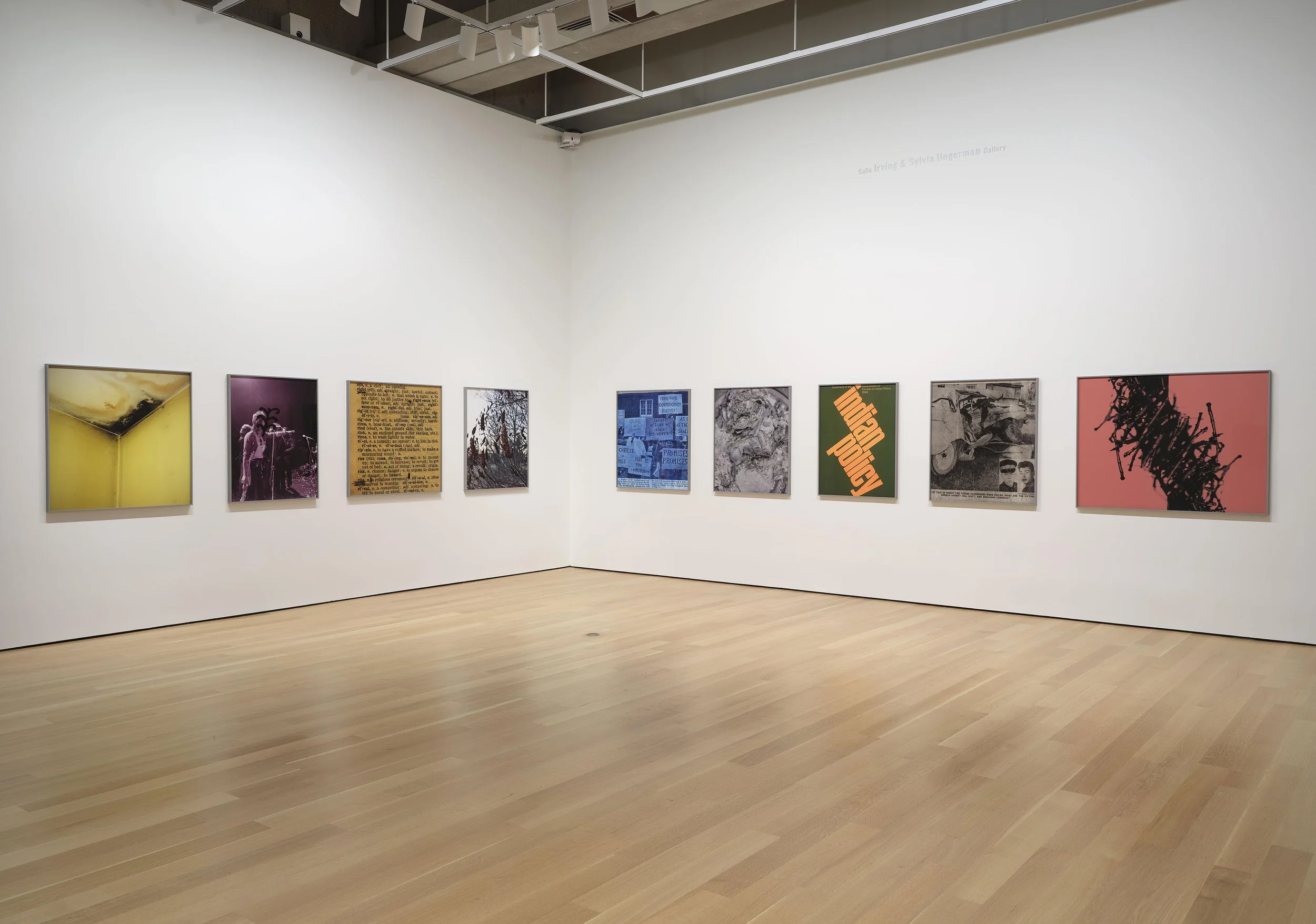
Greg Staats, 1969 (2021), Art Gallery of Ontario installation
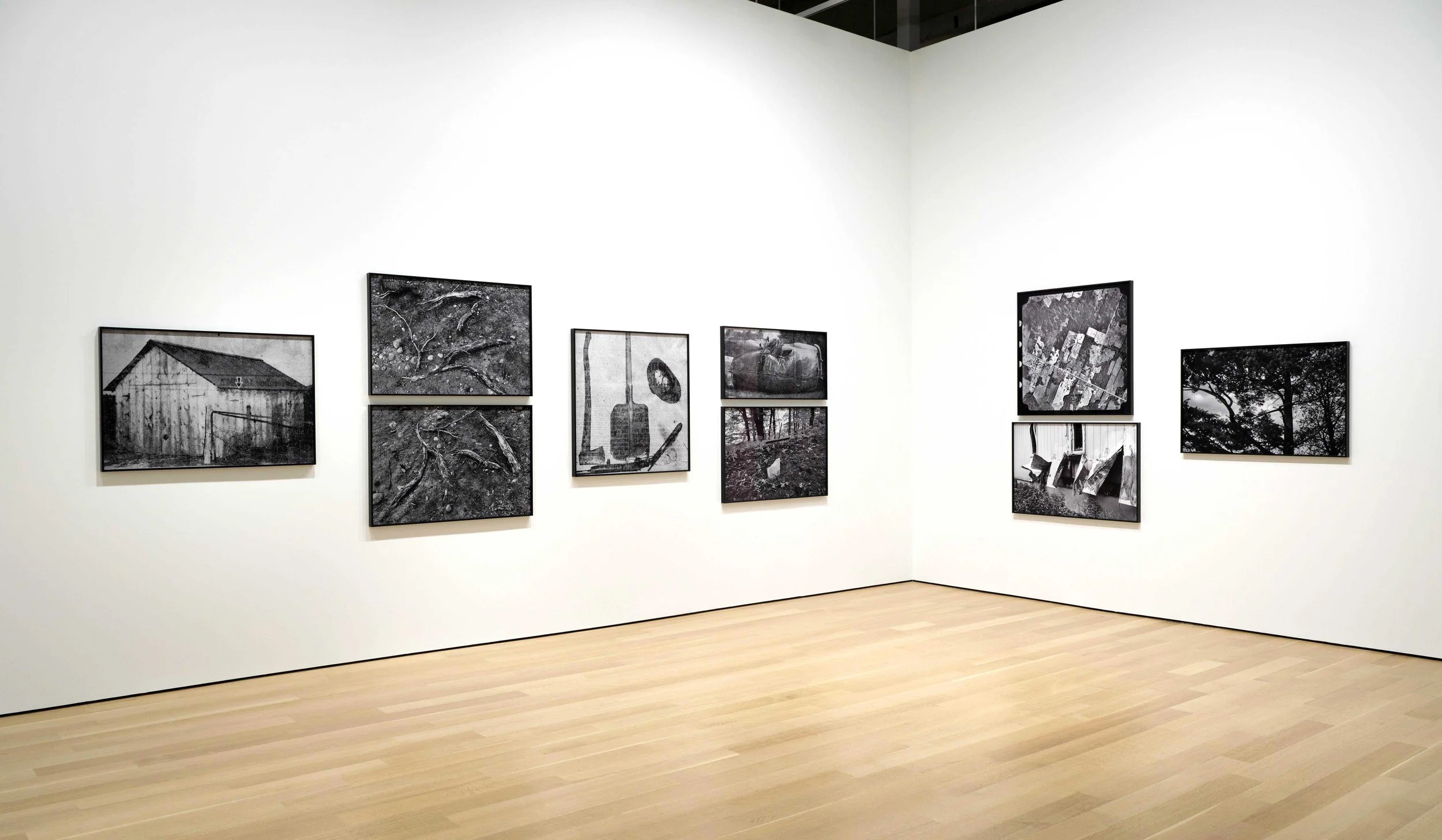
Greg Staats, darkling ease (2021), Art Gallery of Ontario installation
Quisque iaculis facilisis lacinia. Mauris euismod pellentesque tellus sit amet mollis.