Genres High and Low: Writings on Art (2026)
Published by WORK BOOK and Goose and Goose Lane Editions
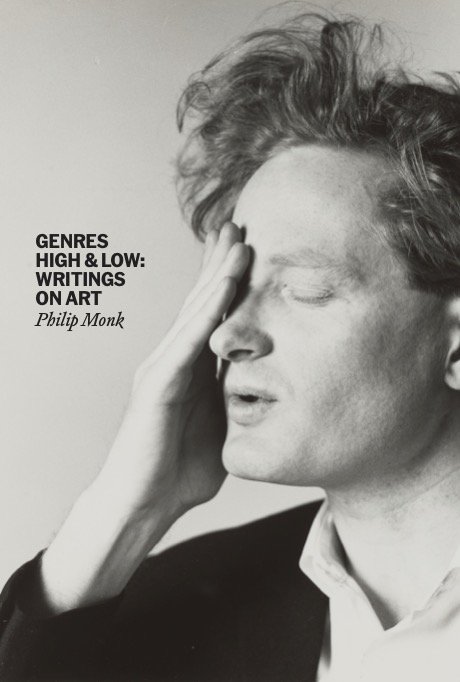
Design: Gilbert Li; photo: © Jorge Zontal for General Idea 1982
Preface
In 1977, wanting to become an art critic, I dropped out of art history studies and published my first article. Those happy days, when I carried on my practice in the downtown Toronto art scene as that odd specimen of a barely paid, independent freelance art critic, came to an end when, in January 1985, surprising me as much as the art community, I became a curator at the Art Gallery of Ontario. Then the identity crisis began: “I’m a curator . . . but also a critic,” I would say. Eventually I settled into my role as a curator. After all, I had chosen curating as a paying means to continue as a writer, not a critic; still, I was a curator for whom writing led. Even when, again unintentionally, I became director of a university art gallery in 2003, I saw the institution and all its products as a writer’s project. Curating added resources to being a writer: an ongoing series of publications—catalogues and books. In retrospect, it was books that made me into a writer.
I loved making books and catalogues, but I also began to see the publication itself, its format and design, as a complementary form of interpretation of the art at hand. Interpretation at a remove, I called it. Even if this was not initially visible to a reader, I wrote my texts with the design of the publication in mind. As in a novel, not everything was admitted up front; the reader had to figure out what was presented, not told. Explanation was embedded in the apparatus, and figured within fictional genres, moreover. Writing assumed a voice, which was not that of the “author.”
My first book, Struggles with the Image, published in 1988, consisted primarily of articles written between 1980 and 1984. Articles were a critic’s métier; reviews did not a critic make. Judgment counted less than articulating the operational concepts of an artist’s work. Genres High and Low consists mainly of catalogue texts and book excerpts, as well as articles and unpublished lectures and texts. It really begins in 1996, although some earlier texts, such as “Local Authority” and “Thinking Through Curating,” are reprinted here. They represent the past. “Local Authority” still addressed my historical pursuits from when I was a critic in the early 1980s; “Thinking Through Curating” elaborated the position I developed as a curator when at the Art Gallery of Ontario, again as it pertained to history but now also to the newly pertinent notion of the canon. In the late 1990s, after The American Trip and Picturing the Toronto Art Community, a different direction imposed itself on my writing—more subjective, personal, and performative, not merely objective and analytic, the carryover from being a critic. Such writing is what this book is about. Yet, the analytic is far from absent, only amplified otherwise as the philosophical procedures that underpin the writing’s conceptual structure.
These two exhibitions—The American Trip and Picturing the Toronto Art Community—marked a shift of subject if not yet of tone in my writing. It was something I perhaps shared with my generation, or at least a few of us in the mid-1990s, of the changed conditions that were affecting curating, museums, and writing. I see it as the application of Leo Steinberg’s notion of the flatbed principle, a shift from visual experience to cultural arrangements, which he elaborated first in a 1968 lecture. Art was no longer a window that looked onto the world but a tabletop on which to arrange pre-given cultural material. The curatorial consequences of learning from artists who adopted these principles, queer onesat that, were outlined in my 1998 article “‘Trash’ as a Cultural System.” In my own case, it led to an interest in the creation of art scenes, the role of photography in disseminating their images, and, through them, the attraction from afar (the suburbs) to these places. A shift to “operational processes” must, of necessity, affect writing, too—the critical writing that addressed visual art, but is no longer necessarily secondary or subordinate to it. Learning from artists, discovering their operational principles, and mimicking their strategies perhaps could only lead, not to expression, but to the disciplinary constraints of writing—its forms, formats, and genres, perhaps to the inventions of fiction itself. Hence, my future experiments with genre, fiction, rule-based writing, pseudonyms, and atypical subject matter, dissemblance, for instance. Above all, writing was a performative practice.
Quisque iaculis facilisis lacinia. Mauris euismod pellentesque tellus sit amet mollis.